Print Acquisitions
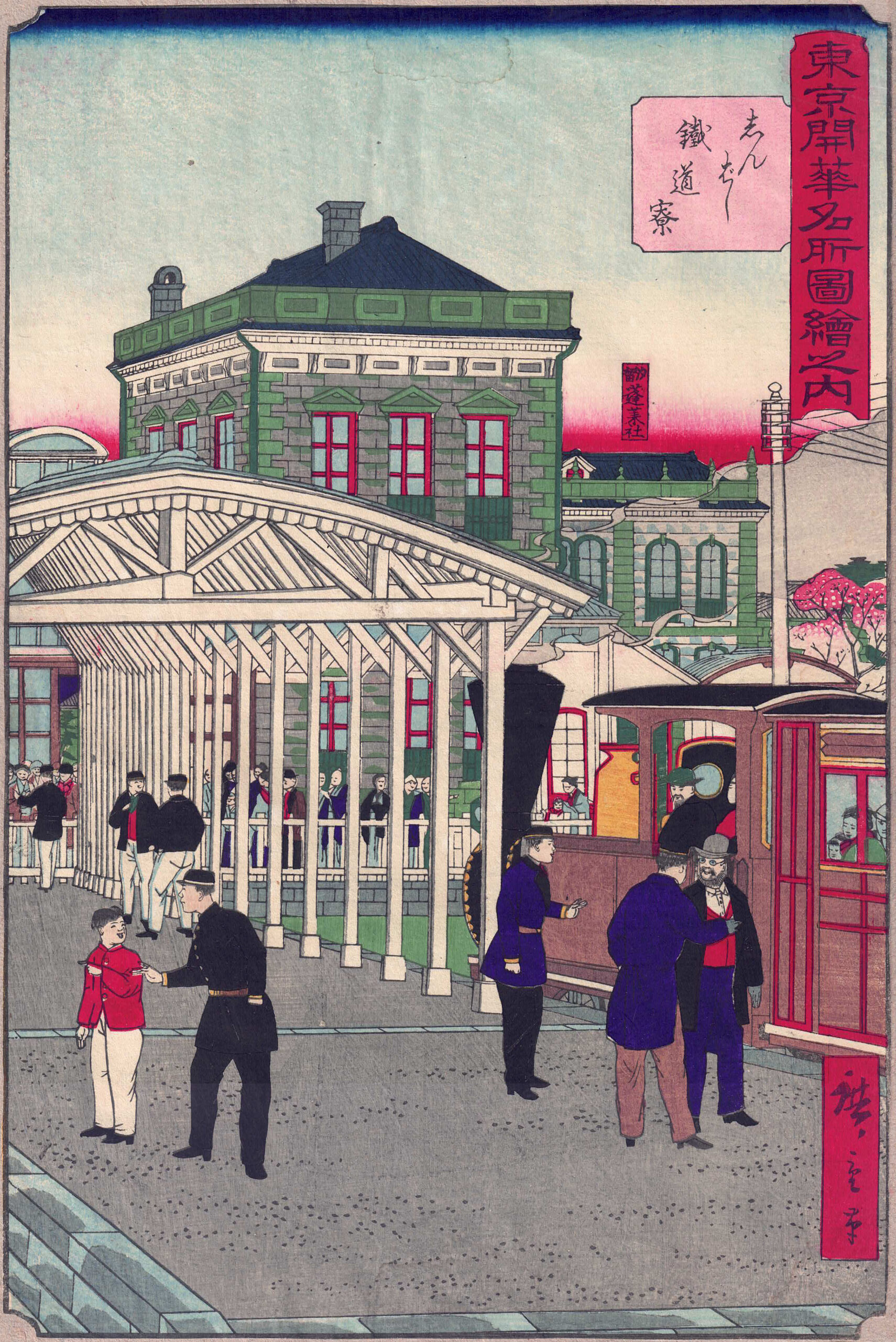
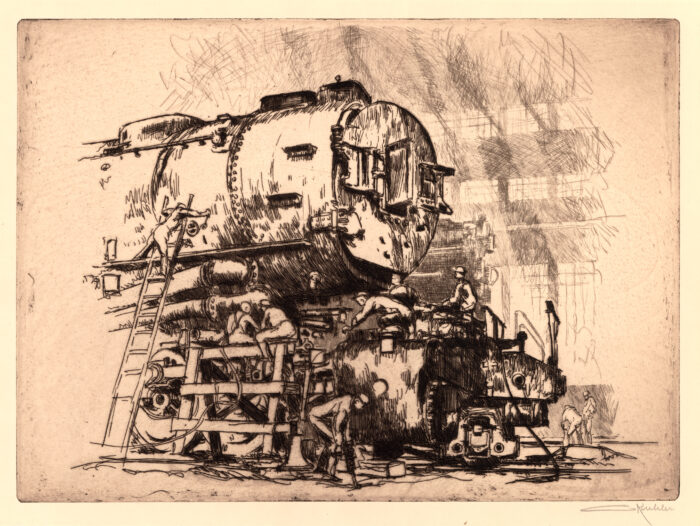
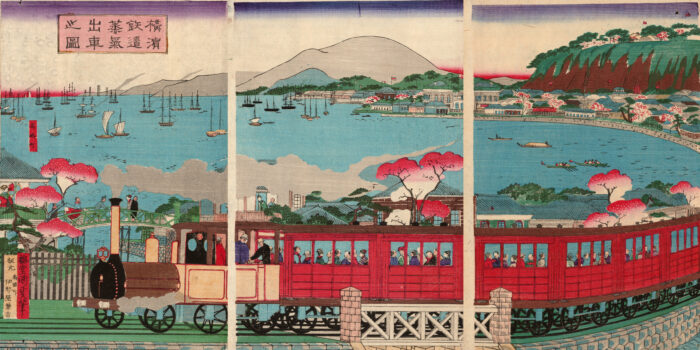
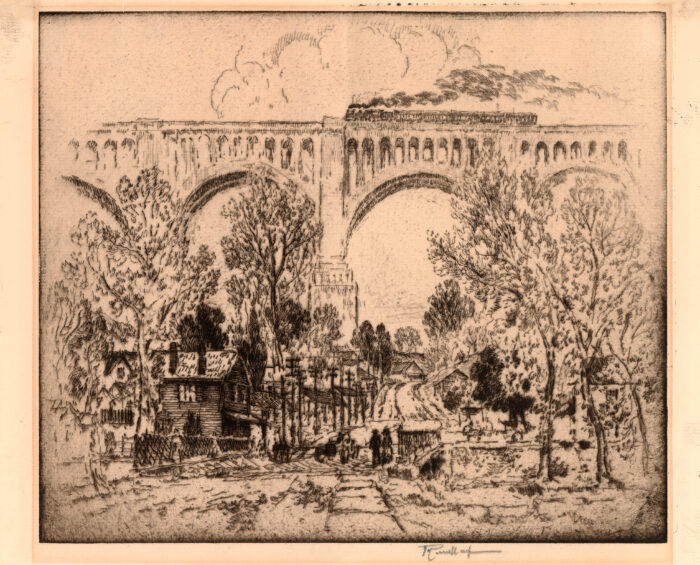
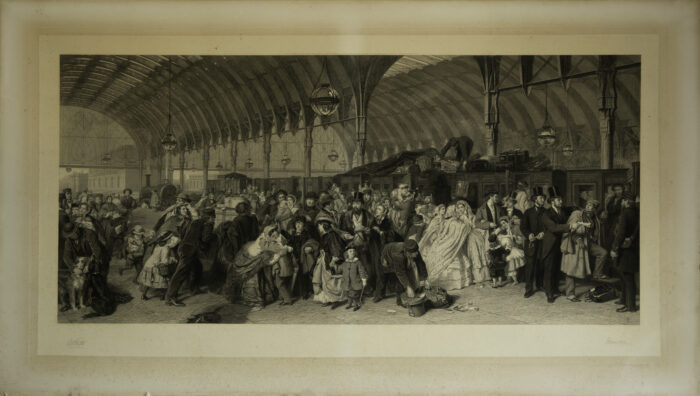
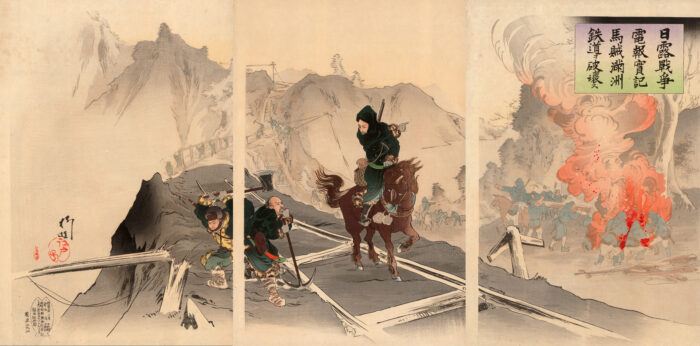
In 2021, CRP&A’s Board of Directors allocated a special fund (now formally named the Print Acquisitions Program) for the purchase of photographs and prints to augment the media and genres already represented in our permanent collections. Under the direction of CRP&A board member and Acquisitions Committee co-chair Peter Mosse, the CRP&A has acquired 50 prints and photographs by the likes of artists such as Thomas Hart Benton, Louis Lozowick, Jospeh Pennell, and Reginald Marsh as part of the program.
Background
For more insight into the Print Acquisitions Program see below for for an abridged interview between Director of Archives and Collections Adrienne Evans and CRP&A Board members Betsy Fahlman, Peter Mosse, and Jeff Brouws. The full interview can be read in OTA 33, which appeared in Railroad Heritage 2024:1.
Adrienne Evans (AE): First, what would you like members to know about the Print Acquisitions Program?
Peter Mosse (PM): I would like to offer a brief explanation of how the Program works, so that readers will be aware of how the Center’s funds are being deployed.
The Board has authorized the Collections & Acquisitions Committee on a year-by-year basis to spend up to a budgeted amount on purchases for the Program. Recognizing that decisions may need to be made quickly, the Committee has delegated its authority to C&A Committee co-chairs Jeff Brouws and myself, together with professional art historian and committee member Betsy Fahlman, to agree on acquisitions, with Executive Director Scott Lothes being kept informed and able to vote on decisions.
For 2021 the budget was set at $2,500 and, in view of the program’s initial success, this was increased to $10,000 for each of 2022 and 2023. Now, in an act of great generosity for which we are profoundly grateful, long-time Center supporter John Mellowes has underwritten the Program’s budget for 2024 and 2025 in the increased amount of $12,500 pa.
Almost all acquisitions so far have been made through placing absentee bids at auction, a mechanism for which I personally have a strong preference over purchasing from dealers or by private treaty. I like the fact that auctions provide price guidance through auction house estimates, and then price transparency through the publication of sale results. It is true that an outlier price needs only two aggressive bidders, but whatever the result, successful bidders know that there was someone else who valued the lot almost as much as they did.
The emergence in recent years of internet search engines using keywords has made it very easy to find potentially interesting lots coming up for sale at a wide range of auction houses and almost all of the Program’s acquisitions have been found this way. Here’s an example of a typical timeline, involving our acquisition of Lozowick’s Steel Valley:
We track our expenditure carefully and we certainly take our budget seriously. Our expenditures in 2021, 2022 and 2023, out of budgets of $2,500; $10,000.00; and $10,000, have been, respectively: $2,463.07; $9,920.24 and $9,843.36.
AE: What inspired you to support the Print Acquisition Program as a major collecting initiative at the Center?
PM: I’m an inveterate collector and have been since childhood when I first started trainspotting in England and recorded seeing just over 10,000 British Railways steam locomotives before the last ones were withdrawn in 1968. Less than fifteen years later I was collecting paintings of railroad subjects and had decided that, with very few exceptions, I would only collect original works of art. My subsequent involvement with the Center and my exposure to the expertise of its directors and members has opened my eyes to the artistic merits of many fine art prints, eroded what I now see as a prejudice against ‘multiples’, and given me the realization that they are an important component of railroad art. This has made the opportunity to work with Betsy, Jeff and Scott in building a collection for the Center from the ground up enormously appealing, as well as educational.
Jeff Brouws (JB): I was well aware of Peter’s painting and fine art print collection (since donated to the Center), and while I can’t recall the exact chain of events, it became obvious that to fulfill our CRPA mission we had to grow beyond just collecting photography. We’re lucky. But I want to chime in here about nomenclature, since my major interest is in photography. Photographic prints can also be / and are referred to, as “fine art.” There are innumerable “fine art photographers” out there. So maybe we need to employ some parenthesis after “Fine Art Print Program” to better define for our audience what were talking about. The Print Acquisition Program to my mind is not only about paintings, etchings, limited edition prints but also included in the proposed nomenclature are vernacular photographs and fine art photographs (which, up to this point, we’ve collected very little of, but I hope to be more proactive about over the next few years, depending on budgets).
AE: For people who are a little less than familiar with art collecting, can you draw a distinction between limited edition prints like those in the Print Acquisition Program versus open edition prints and/or mass-produced images etc.?
Betsy Fahlman (BF): Fine art prints are multiple originals, sometimes signed in the plate (from which it is printed) and more often signed on the print and “editioned.” It is customary to note what number each print is (1, 2, 3, etc). Small editions are best as the plate can degrade if too many prints have been pulled. These prints are in contrast to mass produced prints, which are often low-quality ink jets produced in editions up to 300-500 prints.
AE: Images in the Center’s permanent holdings range from straight, documentary photography to stylized, in some cases almost abstract, photographs, paintings, and prints. I think the majority of us at the Center agree that most approaches to depicting railroading have merit. But what do these more creative depictions have to teach us about the place of railroading in culture and history?
BF: What people thought of railroads can be as important as the more specific documentation with detailed measurements and extensive technical explanations.
PM: I think these depictions show just how pervasive railroads and trains are in culture and history around the world. This may fade to a degree with the passage of time and as railroads become less central to people’s lives in many countries, but I think they still possess an elemental appeal which invites artistic depiction and which will not disappear. I note that barely an issue of a mainstream art magazine goes by without including at least one illustration of a painting with some railroad content, and also that my own collection now includes works from over 25 countries and in a wide variety of styles.
JB: Its importance: railroads have played a major role in shaping history, geography, economics, and culture overall.
AE: What have you learned from your involvement with the Print Acquisition Program?
PM: A lot, but mainly it has accelerated my acceptance of fine art prints as objects worthy of collection, and enabled me to better recognize the artistic talent of skilled printmaking.
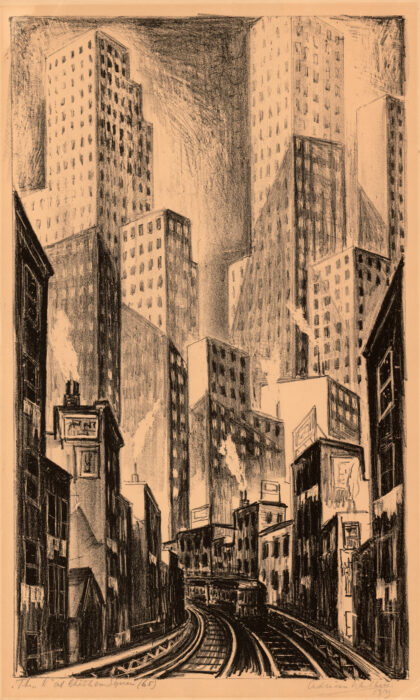
signed, dated and titled in pencil, 14 5/8 x 8 5/8 in. PA-0045
About the collection
Title
Print Acquisition Program
Dates
Span: circa 1866-1993
Creator
Various
Provenance
Acquired by CRP&A between 2021-2026.
Processing history & status
The collection has been fully digitized.
Copyright status
Materials in this collection may be protected by United States Copyright Law and/or by the copyright laws of other countries. Copyright law protects unpublished as well as published materials.
CRPA does not claim to control the rights for reproduction for materials or images in this collection. If CRP&A does not clearly hold the copyright to an item, CRPA cannot grant or deny permission to use that material. Use at your own risk. Written permission from the copyright holders and/or other rights holders is required for publication, distribution, or other use of protected items beyond that allowed by fair use.
Print Acquisition Program index
Extent
50 prints
Availability
All of the print acquisitions have been digitized, and a selection will soon be available in the Center’s digital collections.