We’re deeply saddened to report the passing of David Plowden, one of the giants in American photography and a friend of the CRP&A from its founding. Plowden passed away on May 4th, at age 93; memorial service plans have yet to be determined.
“Getting to know David over the years ranks awfully close to the top of the many incredible experiences I’ve had through the Center,” said Scott Lothes, president and executive director. “He taught us how to see the American landscape … and the railroad’s indelible presence within it.”
Born in 1932, Plowden took up photography in his youth as steam locomotives began to give way to diesels in the U.S. and Canada. Initially wanting to document the machines that he loved before they vanished, he later made a career as, in his own words, “a scribe with a camera, putting down on film what, taken as a whole, amounts to a record of change.”
“I approached photography through the back door, so to speak,” Plowden wrote in his 1982 book An American Chronology. “The camera became for me the means – possibly the only means, given my temperament – by which I could hope to express and assimilate my feelings, observations, and thoughts. It has never been photography per se that concerned me, but, rather, what I saw.”
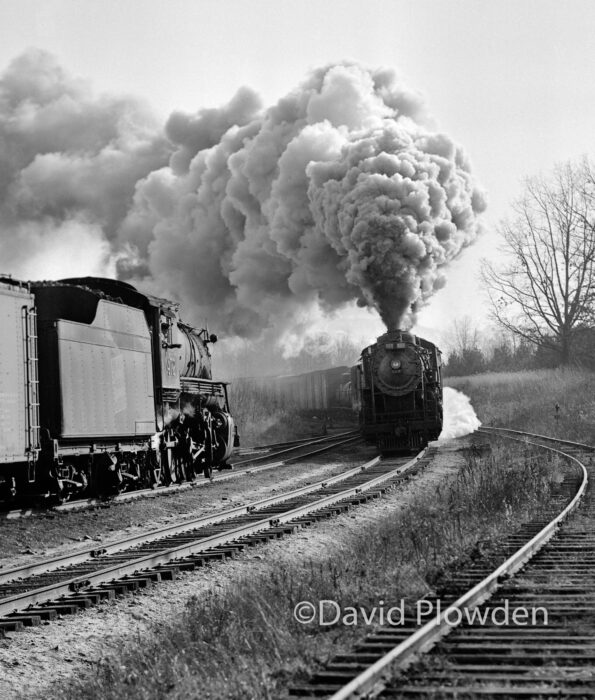
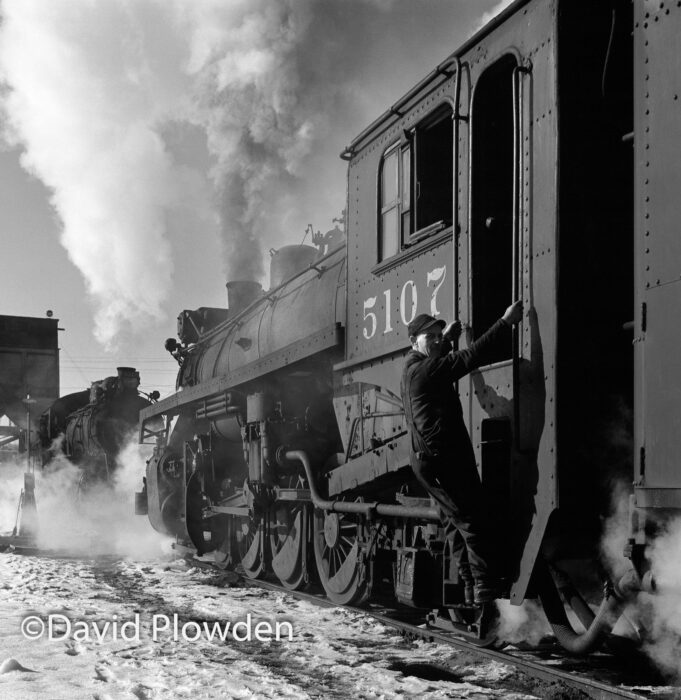
Plowden’s legacy extends far beyond the railroad photos that Center members most likely know best. His subjects also included steamships, steel mills, bridges, barns and other buildings, and more, along with their people and the surrounding landscapes. Made over the course of more than fifty years, his beautifully composed, beautifully printed black & white images capture so much of what many of us think of as America; in fact, the word “America” appears in the titles of eight of the 22 books that he wrote and illustrated. Photos by Plowden exclusively appear in seven books on which he collaborated with co-authors and four more written by other people.
Many organizations supported Plowden’s work, and he received numerous fellowships, grants, and awards including from the National Endowment for the Humanities, the Smithsonian Institution, and the Guggenheim Foundation. Several permanent collections hold his photographs, including the Art Institute of Chicago, the Chicago History Museum, George Eastman House, the International Center for Photography, the Library of Congress, the National Gallery of Art, and the Smithsonian; the Beinecke Library at Yale University (his alma mater) will serve as the repository for his complete archive. The Railway & Locomotive Historical Society presented Plowden with their Railroad History Award in 1989 for his “significant contribution to the photographic interpretation of North America’s railroading history.”
Plowden grew up in New York City and in Putney, Vermont, on the Boston & Maine’s Connecticut River line between Springfield, Mass., and White River Junction, Vt.; he made his first photo, of the steam locomotive on B & M train no. 74 in Putney, at age 11. Although a good student, Plowden found school uninteresting, and he attended eight different ones in three states before graduating from high school. Both of Plowden’s parents provided encouragement and moral support throughout.
At Yale, Plowden studied economics; he did not enjoy that part of his education either, but while in college he did have a photo published in Trains magazine. After graduation, the Great Northern Railway hired Plowden as assistant to the trainmaster, assigning him to Willmar, Minnesota, a hundred miles west of the Twin Cities. Although on the job for only a few months over the winter of 1955-1956, Plowden took advantage of the remote posting to make photos of Mikados on freight trains, and he rode what he called the last steam-powered passenger train on the GN: Second 28, the eastbound Fast Mail. Plowden described his cab ride to St. Paul in the introductory text to his 1987 book A Time of Trains – ten pages of powerful and evocative prose that ranks with the best railroad writing anywhere.
In the next few years, Plowden had a succession of jobs, including as O. Winston Link’s photographic assistant in 1958-1959. In a 1985 interview, Plowden said that he learned from Link that “you could be mad, crazy, and fanatical about something and still make a living” and that “it was possible to do what you wanted to do … but it took a lot of dedication.”
For six months in 1959-1960, Plowden studied with the noted American photographer Minor White – “one of the greatest printers who ever lived,” in Plowden’s estimation. White recognized that his student had other things on his mind. “Go do your damned engines,” White told Plowden. “Get them out of your system or you’ll never do anything else.”
Plowden took that advice and headed for eastern Canada, where the Canadian Pacific still operated numerous steam locomotives of numerous classes in both freight and passenger service. In just a few weeks, from Montreal to the Maritimes, Plowden produced a magnificent body of work – among the many immortal images, Royal Hudsons on commuter trains, hostlers at engine terminals, and perhaps most historically important the “Scoot” mixed train between Lac-Mégantic, Quebec, and Brownville Junction, Maine, on March 29, 1960, the very last day before a diesel took over the job.
After another couple of years as the assistant to a fashion photographer in New York City, Plowden went out on his own, supporting himself and then his growing family doing freelance work for magazines including Architectural Forum, Audubon, Fortune, Life, and Newsweek, among others. As he began self-employment in New York, Plowden developed a close friendship with Walker Evans, the photographer whom some consider one of the most influential artists of the twentieth century and to whose work Plowden’s often gets compared.
Plowden’s exhibition The Route of Lincoln’s Funeral Train went up at Columbia University in New York in 1965, and his first book – Farewell to Steam, about steamboats and locomotives – came out in 1966. Plowden’s work soon appeared also in New York’s Metropolitan Museum of Art, in a 1967 exhibition called Photography in the Fine Arts. Dozens of group and solo exhibitions have followed, from coast to coast in the U.S. and in Canada and Switzerland. The CRP&A has circulated Requiem for Steam: The Railroad Photographs of David Plowden to almost a dozen venues since 2011, including the Grohmann Museum in Milwaukee (which has hosted four other Plowden solo exhibitions since 2013).
Moved to do for others what White and Evans had done for him, Plowden taught at universities between 1978 and 2007 – first the Illinois Institute of Technology, then the University of Iowa School of Journalism, the University of Baltimore, and for sixteen years Grand Valley State University in Allendale, Michigan.
Plowden presented at the very first Conversations conference, in 2003, and alongside CRP&A founder John Gruber at the second, in 2004. Plowden came back to present at Conversations in 2008 and 2010, and in April 2016 he attended the opening reception at Lake Forest College. By the time of that latter evening, Plowden’s health no longer allowed him to go out in the field to make photos, but he talked with eager listeners about his then-current project, working with an assistant to digitize thirteen miles of 2-1/4 film. No longer printing in his darkroom, Plowden reveled in the newfound opportunity to use computer editing to transform his negatives into the images that he wanted. He laughed mischievously as he described how he would call the curator at the Beinecke to say that he’d found some prints that he did not want to go into the archive and then tear newspaper next to the phone, just to hear the curator gasp!
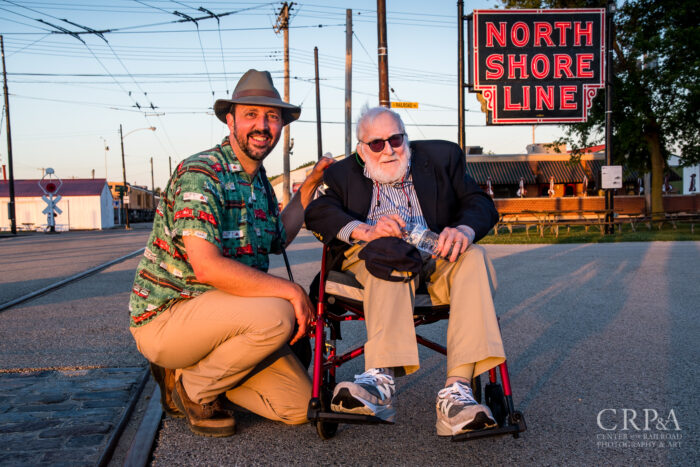
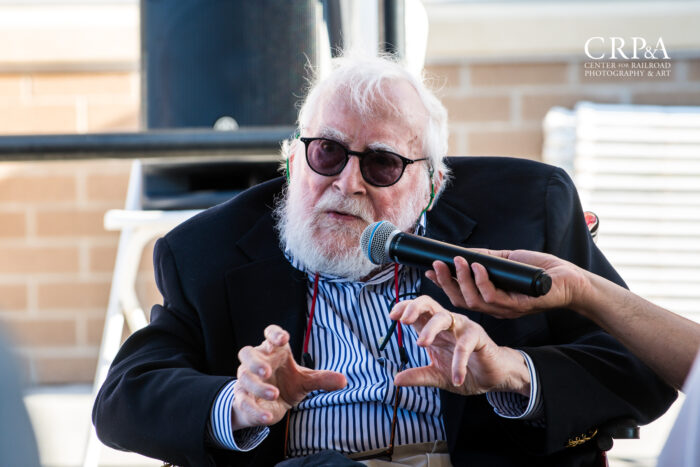
In June of 2024, Plowden spoke to a riveted crowd at the Conversations opening event at the Illinois Railway Museum, where he sat with executive director Lothes and reminisced about his years of photographing – and working on – trains. Family and friends delighted in seeing the rejuvenating effect on a 91-year-old of two hundred of his fans hanging on his words: Plowden spoke animatedly and engagingly, his recollections wholly in focus. He recounted in detail his experiences in Canada 65 years earlier, giving thanks to the many people who helped and showed kindness during his project; these included the Canadian Pacific roundhouse foreman in Macadam, New Brunswick, who had his workers build a darkroom in the building’s basement so Plowden could develop film.
He reminded the crowd at IRM that he always seemed to show up “one step ahead of the wrecking ball,” and indeed, many of his subjects disappeared sooner or later after he photographed them, whether GN 2-8-2s, the carferry Chief Wawatam, or countless barns, grain elevators, and other rural buildings. On that hot June afternoon at the museum, as the sun set on the Midwestern landscape that he had loved and explored and photographed for decades, Plowden reflected on a career seemingly saturated by heartbreak – but throughout it, he said, still seemingly in wonderment at all that he had managed to do and see, “I had so much fun.”
Early tributes celebrate the humble, kind-hearted soul that inspired generations of photographers.
“It was one of the great privileges of my life to meet David, to get to know him and visit with him in his home,” said Bon French, chair of the CRP&A board of directors. “I loved listening to his stories, particularly about his field trips with his students to central Illinois where I am from. Since I knew the territory, he would get quite excited comparing notes on specific tiny towns, highways, grain elevators, railroad crossings and the wide-open countryside. I always felt I was listening to the master, yet David was completely down to earth and humble about his accomplishments.”
“A gentle soul, warm human being, and a great teacher and inspiration to us all,” noted Jeff Brouws, author/photographer and CRP&A board member.
“For all he’s taught us,” added Lothes, “maybe, in the end, David’s greatest lesson is how to say goodbye – with dignity and grace – to so much of what we love.”
With immense gratitude for having had the opportunity to get to know David Plowden and to work with him, the Center staff and board send heartfelt condolences to everyone in his family and to his many friends and admirers.
-Oren Helbok and Elrond Lawrence
(Elrond Lawrence photo)